For the uninitiated, looking at an ultralight hiker’s gear list can be confusing. You might see a claim of a “9-pound base weight,” yet when you lift their pack at the trailhead, it feels closer to 20 pounds. Is the hiker lying? Probably not. They are simply using the specific accounting language of the backpacking world.
Understanding the distinction between worn weight vs base weight is crucial for anyone attempting to lighten their load. It is not just about bragging rights on the internet; it is about understanding exactly where your burden lies and how to manage it. This guide breaks down the math behind the philosophy so you can audit your gear correctly.
The Hierarchy of Backpacking Weight
To organize a packing list spreadsheet effectively, gear is divided into three distinct categories.
- Base Weight: The gear in your pack that does not change (Shelter, Sleep System, Clothing in pack).
- Consumable Weight: The items that decrease as you hike (Food, Water, Fuel).
- Worn Weight: The items attached to your body (Clothing worn, Shoes, Trekking Poles).
What is Worn Weight?
This is the category that causes the most confusion and debate.
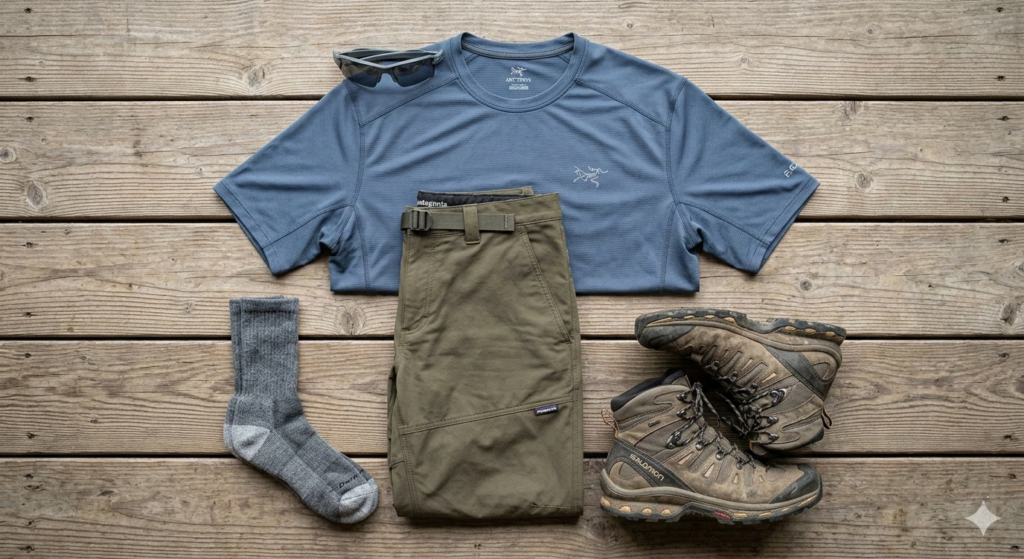
Worn weight refers to any item that is worn on your body or held in your hands for the majority of the hike. This typically includes your hiking shirt, shorts/pants, underwear, socks, trail running shoes, hat, sunglasses, watch, and trekking poles.
The logic behind separating this from your pack weight is simple biomechanics: weight carried on your feet or torso affects your body differently than dead weight pulling back on your shoulders. However, accuracy is key. You cannot guess these numbers. You need to use a precise Digital Gram Scale to weigh your shoes and clothing. Knowing that your boots weigh 3 pounds (1.3 kg) while trail runners weigh 1 pound (0.45 kg) is a critical data point, even if it doesn’t go into your “Base Weight” column.
The “Base Weight” Definition
As we explored in our core guide, “What is Ultralight Backpacking? (And Why It Matters)”, Base Weight is the primary metric for ultralight hikers. It represents the static load your muscles must support regardless of how far you hike.
Base Weight Calculation:
Total Pack Weight – (Food + Water + Fuel) = Base Weight.
This number allows hikers to compare gear lists apples-to-apples. It eliminates the variables of trip length. A hiker doing a weekend trip and a hiker doing a 5-day section hike might have the same Base Weight, even though their Total Pack Weight differs significantly due to food.
The “Cheater” Loophole
A common pitfall when analyzing worn weight vs base weight is the temptation to “cheat” the spreadsheet to achieve a lower base weight number.
Some hikers will mark a heavy fleece jacket or a camera as “worn weight” because they might wear it or carry it around their neck. However, if that item spends 80% of the day inside your backpack, it is Base Weight.
The Golden Rule of Gear Grams: Your knees do not care what your spreadsheet says. If you move a heavy item from your pack list to your worn list but still carry it, your body suffers the same impact. Be honest with your data. If you carry a fanny pack with snacks and electronics, that is generally considered Base Weight (or Consumable) because it is weight supported by your hips, not your own body structure.
Skin Out Weight (FSO)
If you want the most honest assessment of your physical burden, look at “Skin Out Weight” (sometimes called FSO – From Skin Out).
Skin Out Weight = Base Weight + Consumables + Worn Weight.
This is the total mass you are moving up the mountain. While Base Weight is useful for gear optimization, Skin Out weight is useful for physical preparation. If your FSO is 30 pounds, your legs must be conditioned to move 30 pounds, regardless of whether that weight is water, a tent, or heavy boots.
Summary: How to Categorize Tricky Items
Here is a quick reference guide for commonly miscategorized items:
- Trekking Poles: Worn Weight (if you use them). If they are strapped to the pack, they are Base Weight.
- Smartphone: Worn Weight (if in your pocket). Base Weight (if in the pack brain).
- Bear Canister: Base Weight (the canister itself). The food inside is Consumable.
- Water Bottles: Base Weight (the empty bottle). The water inside is Consumable.
- Fuel Canister: Base Weight (the empty metal can). The gas inside is Consumable.
Conclusion
Mastering the math of worn weight vs base weight is the first step toward true ultralight proficiency. By accurately weighing your gear and categorizing it honestly in your packing list spreadsheet, you gain visibility into where your heavy items are hiding. Remember, the goal is not to hit a specific number on a screen, but to feel lighter and more agile on the trail.
Frequently Asked Questions (FAQ)
1. Why don’t we count water in Base Weight?
Water weight fluctuates constantly. You might start with 2 liters (4.4 lbs), drink half of it, and then refill. Because it is a variable “consumable,” excluding it provides a consistent baseline for your gear kit.
2. Does a fanny pack count as worn weight?
There is debate on this. Purists count the fanny pack itself and its contents as Base Weight because it is a storage vessel adding load to your hips. Others count it as worn weight. The safest bet: if it holds gear, count it as Base Weight.
3. What is a good “Worn Weight” target?
This depends heavily on the season. In summer, worn weight might be 3-4 lbs (shoes + shorts + shirt). In winter, it could be 8-10 lbs (boots + heavy layers). Focus on lightweight, breathable clothing and trail runners to keep this low.
4. Should I weigh my socks and underwear?
Yes. While it seems extreme, weighing everything teaches you about material weights. You might find that a certain pair of synthetic socks is double the weight of a merino wool pair. Every gram counts over a million steps.
5. How do I calculate fuel weight?
Weigh a full canister, then weigh an empty canister (you can find specs online). The difference is your consumable fuel. The weight of the empty metal canister is part of your Base Weight.