For generations, the standard image of backcountry camping has featured a domed nylon tent. However, as hikers push to travel lighter and faster, many are realizing that a fully enclosed tent is often unnecessary. Tarp camping strips wilderness shelter down to its absolute, most efficient core: a waterproof roof over your head.
Transitioning from a freestanding tent to a simple sheet of fabric can feel intimidating. Without fiberglass poles to hold the structure up, the responsibility of creating a weatherproof home falls entirely on your skills. This guide will demystify the process, teaching you the foundational techniques needed to confidently sleep under a tarp.
Understanding the Tarp Shelter System
Before wrestling with fabric in the wind, it is vital to understand the mechanics of what you are building.
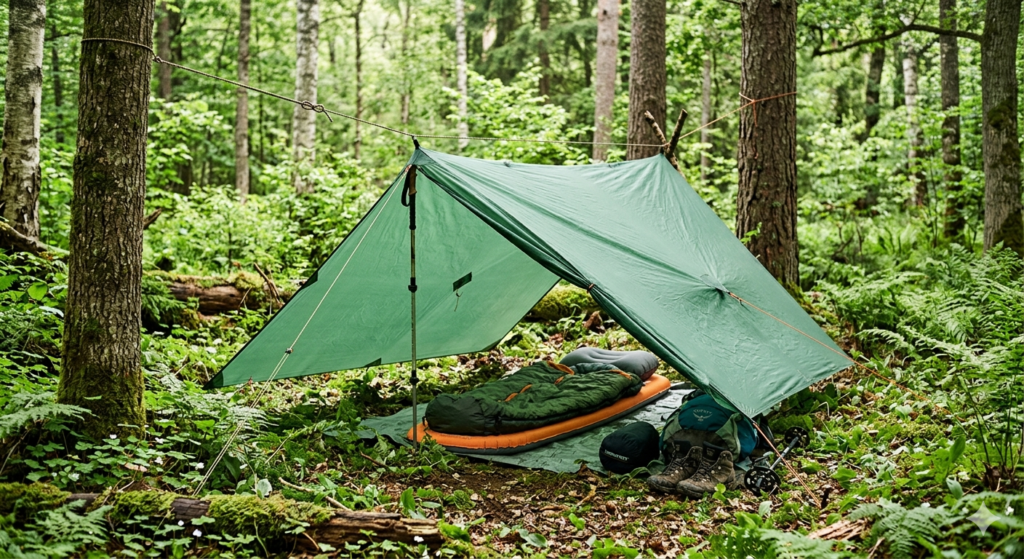
Knowing how to use a tarp for camping involves utilizing a single sheet of waterproof fabric, suspended by trekking poles and secured with guy lines, to create a minimalist shelter. This system relies on specific knots and site selection to provide weather protection at a fraction of a tent’s weight.
Unlike a traditional tent that pops into shape, a tarp requires tension to maintain its structure. If the tension is lost, the shelter sags or collapses.
The Anatomy of a Tarp Setup
A successful pitch requires three primary components working together in harmony.
- The Canopy: This is the tarp itself. Beginners often start with a rectangular “flat tarp” (typically 8×10 feet) because of its immense versatility.
- The Supports: To create headroom, you must prop the fabric up. Most ultralight hikers construct a makeshift trekking pole tent by using their adjustable hiking poles as the primary vertical supports. If you do not use poles, you can tie the tarp to sturdy trees.
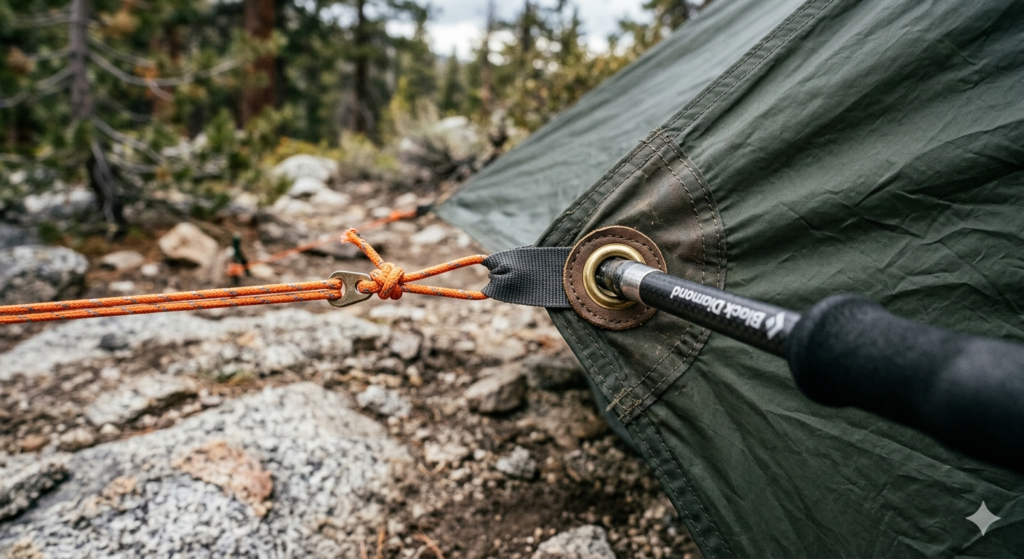
- The Cordage: You must anchor the fabric to the ground using stakes and guy lines. Because these lines hold the entire structure under immense tension, using a high-quality, non-stretch dyneema guyline cord is crucial. If your cordage stretches during a rainstorm, your roof will sag onto your sleeping bag.
Essential Tarp Knots You Must Know
You do not need to be a master sailor to pitch a tarp, but you do need to memorize two or three reliable tarp knots.
- The Bowline: Use this knot to create a secure, fixed loop at the end of your guy line to attach it to the tarp’s tie-out loops. It will not slip under tension but is easy to untie.
- The McCarthy Hitch (or Taut-line Hitch): This is an adjustable friction hitch used at the stake end of your guy line. It allows you to slide the knot up and down the cord to add or release tension on the tarp without having to move the metal stake in the dirt.
Practicing these knots at home until you can tie them with cold fingers in the dark is a mandatory step for any beginner.
The Classic A-Frame (Flat Tarp Setup)
The A-Frame is the most reliable and common flat tarp setup. It provides excellent rain runoff and a comfortable amount of headroom.
- Lay it Flat: Spread the tarp flat on the ground.
- Stake the Back: Stake down the two rear corners of the tarp directly to the ground.
- Insert the Rear Pole: Prop up the rear center of the tarp using a trekking pole (set to a low height) and stake out the rear center guy line.
- Insert the Front Pole: Move to the front. Insert your second trekking pole (set higher than the rear) into the front center tie-out. Pull the front guy line taut and stake it down.
- Tension the Corners: Finally, pull the remaining front corners out to create a taut, wrinkle-free triangle shape and stake them down.
Site Selection is Your True Shelter
When you remove the bathtub floor and mesh walls of a tent, where you sleep becomes just as important as what you sleep under.
As highlighted in our foundational guide on Essential Minimalist Camping Skills for Ultralighters, your environment dictates your comfort. When pitching a tarp, you must anticipate the wind. Pitch the low end of your A-Frame pointing directly into the prevailing wind. This aerodynamic shape forces the wind up and over your shelter, rather than catching it like a parachute.
Additionally, always look at the ground. Because you do not have a waterproof floor, pitching a tarp in a slight depression will result in water pooling underneath your sleeping pad if it rains. Always pitch on slightly domed or gently sloped ground that promotes natural drainage.
Conclusion
Learning how to use a tarp for camping is a profound step in any backpacker’s journey. It transforms you from a passive consumer of outdoor gear into an active participant in your environment. By mastering the basic tarp knots, investing in strong guy lines, and practicing the fundamental flat tarp setup, you can safely shed pounds from your backpack while enjoying an unparalleled connection to the wilderness around you.
Frequently Asked Questions (FAQ)
1. Do I need a ground sheet when using a tarp?
Yes. Because a tarp does not have a floor, you need a protective layer between your sleeping pad and the dirt. A piece of lightweight Tyvek or polycryo window shrink film works perfectly to protect your gear from mud and punctures.
2. How do I deal with mosquitoes and bugs?
During heavy bug season, tarp campers use a “bug bivy” (a minimalist mesh sleeping bag cover) or pitch a lightweight, floorless mesh inner-net underneath the tarp canopy to keep insects away while sleeping.
3. Is a shaped tarp better than a flat tarp?
Shaped tarps (like pyramids or catenary-cut tarps) are generally easier and faster to pitch because their geometry is pre-sewn. Flat tarps require more skill to pitch tightly, but they offer far more versatility, allowing you to create different shapes (A-frame, lean-to, diamond) depending on the weather.
4. What should I do if the wind changes direction at night?
If a severe storm shifts and begins blowing rain into the open front of your A-Frame, you may need to get out and adjust your pitch. You can lower the front trekking pole significantly to close the opening and block the incoming weather.
5. Will a tarp keep me warm?
A tarp blocks wind and rain, which prevents convective heat loss, but it does not trap ambient heat like a double-wall tent. You will sleep at the exact temperature of the outside air, so you must rely entirely on your sleeping bag and clothing for insulation.