Walk into any outdoor retailer or browse an online hiking forum, and you will likely be bombarded with terminology describing gear weight. Terms like "ultralight," "super ultralight," and "traditional" are often thrown around loosely, leading to confusion for beginners who just want to enjoy the trail.
Understanding the difference between ultralight vs lightweight hiking is about more than just bragging rights or hitting an arbitrary number. It helps you set realistic goals for your gear system and understand the trade-offs between camp comfort and hiking efficiency. This guide breaks down the specific pack weight categories and what they mean for your hiking experience.
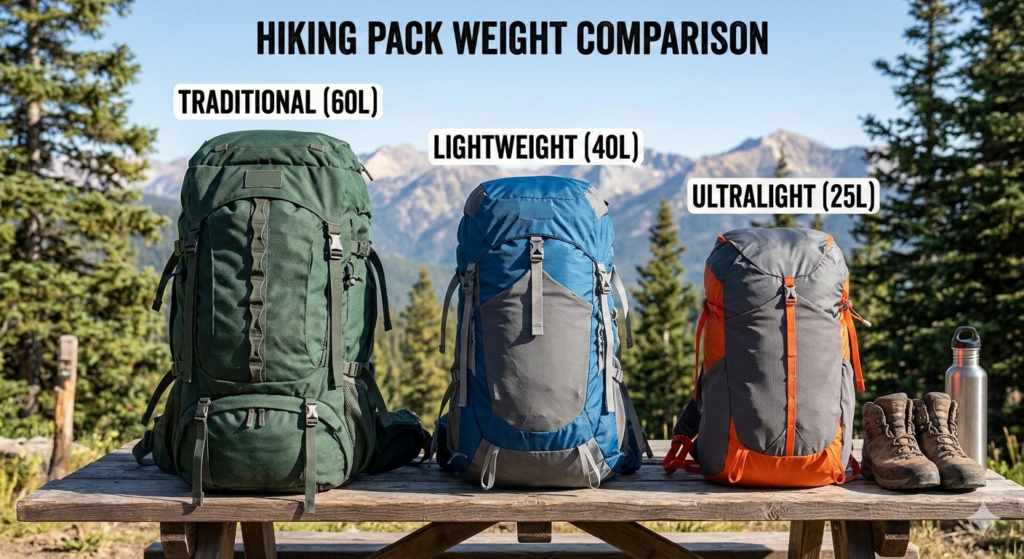
The Weight Spectrum Defined
To categorize hiking styles, the outdoor community uses "Base Weight"—the weight of your pack excluding food, water, and fuel.
The primary difference in ultralight vs lightweight hiking is the base weight threshold. Lightweight hiking is defined as a base weight between 10 and 20 pounds (4.5–9 kg), offering a balance of comfort and agility. Ultralight hiking requires a base weight under 10 pounds (4.5 kg), prioritizing speed and minimalism.
These categories are not rigid laws, but they serve as useful benchmarks for auditing your gear.
1. Traditional Backpacking (> 20 lbs)
This is the most common style for beginners or those who prioritize luxury at camp over mileage.
- The Gear: Heavy, durable equipment. Think external frame packs, thick sleeping pads, and full camping chairs.
- The Pro: Maximum comfort once you stop hiking. You are prepared for almost any situation.
- The Con: High physical strain. Heavy packs lead to slower movement and increased fatigue.
2. Lightweight Hiking (10–20 lbs)
Lightweight hiking is the sweet spot for the majority of long-distance hikers. It represents a conscious effort to trim fat without sacrificing safety or significant comfort.
- The Gear: You might use a standard tent but swap the heavy fiberglass poles for aluminum. You carry a lighter sleeping bag but keep your inflatable pillow.
- The Mindset: You are willing to leave the camp chair and heavy boots behind, but you aren't ready to sleep under a tarp.
- Who is this for? Hikers transitioning away from heavy loads who still want a conventional camping experience.
3. Ultralight Backpacking (< 10 lbs)
As detailed in our guide on What is Ultralight Backpacking? (And Why It Matters), this style requires a shift in philosophy.
- The Gear: Frameless backpacks, trekking pole shelters (or tarps), and quilts instead of sleeping bags.
- The Mindset: Skills replace gear. You rely on site selection and layering rather than heavy insulation and bombproof tents.
- Who is this for? Thru-hikers, fast-packers, and those with physical limitations (knees/back) who need to minimize impact.
4. Super Ultralight / SUL (< 5 lbs)
Super ultralight is the extreme end of the spectrum.
- The Gear: A poncho tarp, a torso-sized foam pad, and no stove (cold soaking food only).
- The Mindset: Absolute minimalism. This is often reserved for "Fastest Known Time" (FKT) attempts or summer trips where weather risks are low.
- The Con: The margin for error is razor-thin. If the weather turns unexpectedly, SUL hikers can be at risk.
How to Track Your Category
You cannot guess your way into a category; you have to measure it. The most effective way to determine your standing in the ultralight vs lightweight debate is to weigh every single item you own.
Once you have the raw data, you need a way to organize it. The industry standard tool for this is LighterPack. This free online tool allows you to input your gear weights, categorize them (Sleep, Shelter, Kitchen), and visualize your base weight with a pie chart. Seeing that your "misc" bag weighs 3 pounds is often the shock needed to move from Traditional to Lightweight.
Which Style is Right for You?
There is no "correct" way to backpack. The goal is to match your hiking styles to your objectives.
- If you are hiking 25 miles a day on the Pacific Crest Trail, an ultralight kit will prevent injury.
- If you are hiking 3 miles to a lake with friends to fish and spend some quality time, a traditional or lightweight setup is perfectly appropriate.
Don't obsess over the label. Focus on the utility. If dropping 5 pounds moves you from "miserable" to "happy," that is a win, regardless of whether you hit the 10-pound mark.
Conclusion
The debate of ultralight vs lightweight ultimately comes down to a trade-off between camp comfort and trail comfort. Lightweight hiking (10-20 lbs) offers a forgiving middle ground, while ultralight hiking (<10 lbs) offers maximum freedom of movement for those willing to refine their skills. By using tools to track your gear and understanding these base weight ranges, you can curate a pack that serves your specific adventures.
Frequently Asked Questions (FAQ)
1. Is lightweight hiking expensive?
Not necessarily. While ultralight gear (like Dyneema tents) can be very expensive, "lightweight" status is often achieved simply by leaving unnecessary items at home. You can reach a 15lb base weight using affordable gear from general sporting goods stores.
2. What is "Skin Out" weight?
"Skin Out" weight (or "From the Skin Out") refers to the total weight of everything on your body, including the clothes you are wearing, your shoes, your trekking poles, and your fully loaded pack. Base weight only counts what is *in* the pack.
3. Can I be ultralight in the winter?
It is very difficult. Winter hiking requires heavier insulation, 4-season tents, and more fuel. Most ultralight hikers accept a "Winter Base Weight" that is higher (often 12–15 lbs) to ensure safety in freezing conditions.
4. Do I need a frameless pack for lightweight hiking?
No. Frameless packs are generally recommended only when your total pack weight (gear + food + water) stays under 20-25 lbs. For a standard lightweight setup (10-20 lb base weight), a pack with a light internal frame is often more comfortable.
5. What is the "Big 3"?
The "Big 3" refers to your Shelter, Sleep System (Sleeping bag + pad), and Backpack. These are the heaviest items in your pack. Reducing the weight of these three items is the fastest way to transition from Traditional to Lightweight or Ultralight.